
Why We Offer Dragons of the Spectrum: A Structured, NDIS-Friendly Social Learning Program
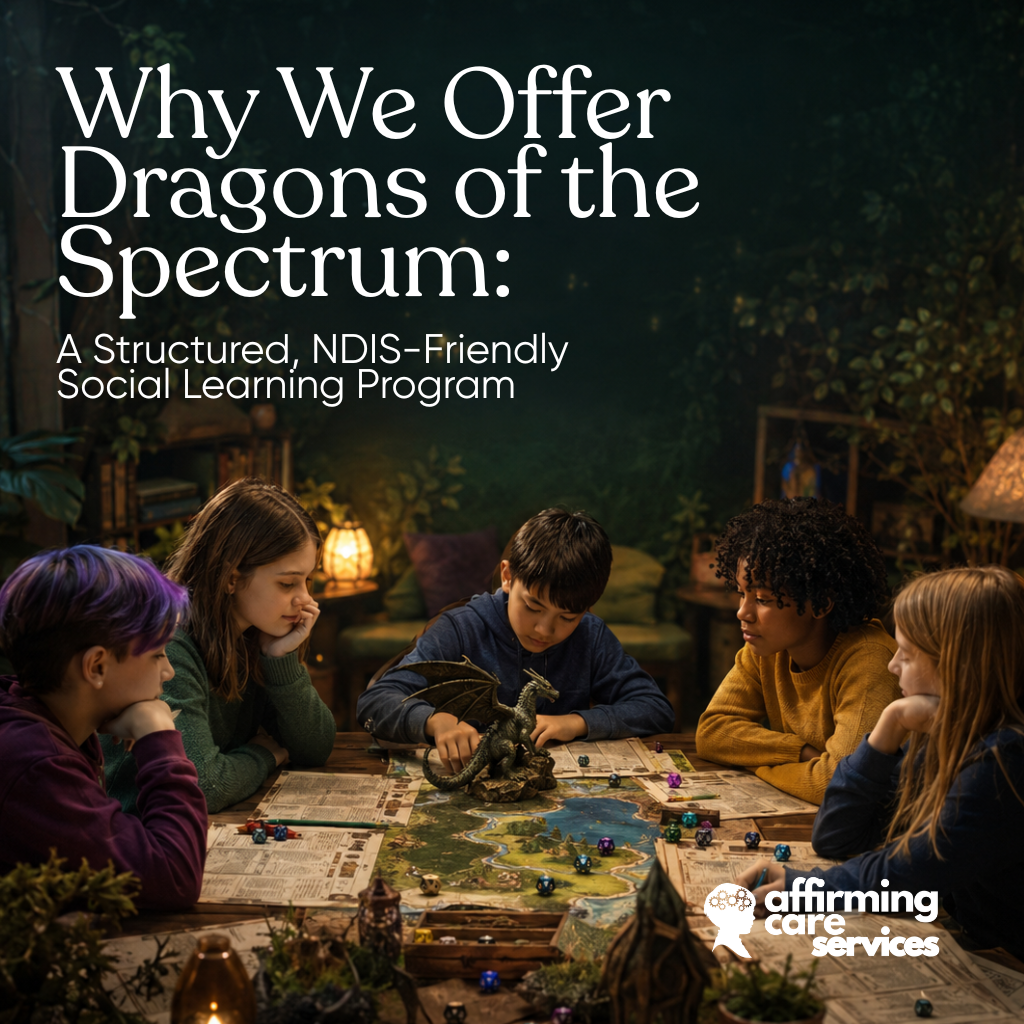
Many families are understandably cautious about using their child’s NDIS funding for a group program.
They may worry that a plan manager will see the word “game” and decide the support is recreational. They may be unsure whether a role-playing program counts as capacity building or whether there is enough evidence to show what their child is learning.
This uncertainty can leave families reluctant to use funding that was intended to help their child build skills, independence and community participation.
It is also one of the main reasons Affirming Care Services chose to offer Dragons of the Spectrum, commonly known as DOTS.
What is Dragons of the Spectrum?
Dragons of the Spectrum is a structured social and emotional learning program developed by clinical psychologist William Ellison. It uses a simplified tabletop role-playing game to help neurodivergent children and young people practise important skills through collaborative storytelling and play.
Participants create characters, explore a fantasy world and work together to solve challenges. While the adventure makes the program engaging, every session also creates supported opportunities to practise skills such as:
communicating ideas and needs
listening and responding to others
working cooperatively
navigating different opinions
solving problems as a group
managing frustration and uncertainty
thinking flexibly when plans change
recognising emotions and perspectives
building confidence within a peer group
repairing misunderstandings and resolving conflict
It may look like a fantasy adventure from the outside, but underneath the story is a carefully structured social learning program.
You can learn more about the program through the Social Play Academy.
Why is DOTS well suited to NDIS funding?
NDIS supports must relate to a participant’s disability support needs, help them pursue their goals, represent value for money and be likely to be effective and beneficial.
DOTS is designed to build functional social and emotional capacity. It is not simply a recreational Dungeons & Dragons club or an unstructured opportunity to spend time with other children.
The program has planned learning content, therapeutic goals, trained facilitation and structured opportunities for children to practise skills in real time.
This makes it possible to clearly explain:
why the support is being provided
which functional needs it addresses
what skills the participant is working towards
how the activities relate to their NDIS goals
how participation and progress will be monitored
The NDIS specifically describes capacity-building supports as supports that can help participants develop social skills, form relationships, connect with others and increase their independence. DOTS can align particularly well with goals involving social communication, emotional regulation, relationships, confidence and community participation.
More information is available on the NDIS website under capacity-building supports.
More than just playing a game
A common concern is that the NDIS will not fund something if it is enjoyable.
However, a support does not stop being therapeutic simply because a child wants to attend.
In fact, engagement is one of the strengths of DOTS. Many neurodivergent children find traditional social skills groups uncomfortable, overly demanding or disconnected from their interests. They may know what an adult expects them to say during a worksheet or discussion but find it much harder to use that skill in a real interaction.
DOTS provides a meaningful reason to communicate and collaborate. Children need to explain their ideas, make group decisions, respond to unexpected events and consider what their teammates might need. These situations emerge naturally within the adventure, allowing facilitators to provide support at the moment the skill is needed.
The fantasy setting also gives participants some emotional distance. A child can explore conflict, mistakes, uncertainty and different perspectives through their character, without every conversation feeling personally exposing.
Interest-based learning is not an extra reward added after therapy. In DOTS, it is the vehicle through which capacity building occurs.
Structured and evidence-informed
DOTS is a structured and manualised program rather than a general gaming group. Facilitators receive specific training in its session framework, therapeutic goals, activities, group dynamics and adaptations for different participants.
The program grew from clinical research undertaken by its creator and has shown promising early results in areas including prosocial behaviour, resilience and social development. Its developers continue to collect outcome data as the program expands.
More broadly, emerging research suggests tabletop role-playing games can provide useful opportunities to practise communication, teamwork, flexible thinking, emotional regulation and collaborative problem-solving. A 2024 scoping review of tabletop role-playing games found growing evidence of cognitive and psychosocial benefits, while also noting that further high-quality research is still needed.
This distinction matters. We do not need to overstate the evidence or promise a particular result for every child. What DOTS provides is an evidence-informed program with a clear developmental rationale, defined learning content and a structured method of delivery.
Clear individual goals
“Attending a social group” is not a particularly useful goal on its own.
Before participating, we consider how DOTS relates to the individual child’s needs and existing NDIS goals. Their personal capacity-building goals might include:
contributing an idea within a group
communicating when they disagree or need help
coping when an activity does not go as expected
participating in shared decision-making
recognising early signs of frustration or overwhelm
using strategies to remain engaged during uncertainty
understanding another person’s point of view
recovering after a mistake or social misunderstanding
developing confidence in a small peer group
These individual goals give the program a clear therapeutic purpose. Families are not simply paying for their child to play a game. They are funding structured support that uses role-play and shared interests to build functional skills.
Assessment and progress reporting
Another important reason we selected DOTS is that progress can be monitored and documented.
Information gathered before the program helps us understand the participant’s strengths, support needs, interests and priority areas. This gives us a starting point for identifying individual goals and considering whether the group is a suitable fit.
Throughout the program, facilitators can observe how the participant approaches communication, teamwork, problem-solving, emotional regulation and unexpected changes. We can document emerging skills, areas where support is still required and the conditions that help the participant engage successfully.
Families can then receive a meaningful summary of:
the skills addressed during the program
the participant’s engagement and participation
progress towards individual goals
strategies that supported them
areas for continued capacity building
recommendations for future support
This documentation helps demonstrate how the participant’s NDIS funding has been used. It may also provide useful information for plan reassessments, progress reports and conversations with the participant’s wider support team.
A neuroaffirming approach to social development
At ACS, the purpose of social learning is not to make neurodivergent children appear more neurotypical.
We are not teaching children to mask discomfort, force eye contact, suppress their communication style or agree with others simply to be seen as socially successful.
Instead, DOTS allows us to support children to understand themselves and others while maintaining their identity and autonomy. We focus on authentic communication, self-advocacy, shared problem-solving, emotional safety and relationships in which different people can contribute in different ways.
Children are encouraged to use their creativity, knowledge, humour and individual strengths. They are not expected to participate in exactly the same way as everyone else.
The goal is greater confidence and capacity, not greater conformity.
Practising skills while they are actually needed
One of the challenges with traditional social teaching is that a child may understand a concept during an individual session but struggle to use it when interacting with peers.
DOTS creates a supported middle ground.
The situations are real enough to require teamwork, flexibility and communication, but safe enough for facilitators to pause, offer support and help participants try another approach.
Within one adventure, a group might need to negotiate a plan, cope with a surprising outcome, respond to a teammate’s idea, manage disappointment and recover from a disagreement. These are the same underlying capacities children draw upon at school, in community activities and when developing friendships.
The game provides repeated practice without requiring facilitators to manufacture artificial social scenarios.
Can my child’s NDIS funding be used for DOTS?
If DOTS relates to your child’s disability support needs, current funding and NDIS goals, it may be an appropriate use of their plan.
Relevant goals might involve:
social communication
emotional regulation
developing relationships
increasing confidence
participating in groups
building independence
improving community participation
managing change, conflict or uncertainty
No provider can guarantee that every support will be payable from every NDIS plan. Capacity-building categories are stated, meaning funding generally needs to be used for the purpose described within that particular category. Individual plans, funding arrangements and restrictions can also differ.
However, DOTS has several features that make its therapeutic purpose easier to explain to plan managers and the NDIS:
it is a structured and manualised program
it is delivered by trained facilitators
it addresses functional social and emotional capacity
it includes clear individual goals
it provides repeated supported practice
progress can be observed and documented
participation can be linked directly to relevant NDIS goals
The NDIS considers whether a support relates to the participant’s disability, helps them pursue their goals, represents value for money and is likely to be effective and beneficial. These are the elements we consider when helping families determine whether DOTS is appropriate. You can read the full criteria on the NDIS page explaining reasonable and necessary supports.
We can help you check before enrolling
Families should not have to feel as though they are taking a gamble each time they use their child’s funding.
Before enrolment, ACS can help you consider whether DOTS aligns with your child’s needs, NDIS goals and available funding. We can also provide clear information about the program’s structure, therapeutic purpose, costs and intended outcomes for you to share with your plan manager, support coordinator or other relevant professional.
We chose Dragons of the Spectrum because it brings together something many neurodivergent children genuinely enjoy with structured, purposeful capacity building.
The adventure may happen in a fantasy world, but the confidence, connection and skills children develop can be carried into everyday life.
