
When Behaviour Strategies Make Things Worse: Understanding PDA in the Classroom
A student is asked to put away their drawing and begin a writing task. They argue, distract the students around them and attempt to negotiate their way out of it. When the teacher repeats the instruction, the student becomes increasingly distressed. A consequence is introduced. The situation escalates.
From the outside, this may look like defiance. It may seem as though the student is deliberately challenging authority, avoiding work or attempting to control the classroom.
For a student with a PDA profile, however, the request itself may have triggered a powerful stress response. By the time the interaction becomes visible to everyone else, the student’s nervous system may already be fighting to regain a sense of safety and autonomy.
When educators understand what may be driving the behaviour, the response can change. That change can make an enormous difference to the student, the educator and the entire classroom.
What is PDA?
PDA commonly stands for Pathological Demand Avoidance. Many autistic people, families and neuroaffirming practitioners prefer the term Persistent Drive for Autonomy, as it describes the need behind the response without framing the person as disordered or deliberately difficult.
PDA is generally understood as a profile associated with autism in which everyday demands and perceived losses of autonomy can trigger significant distress. It is not currently recognised as a standalone diagnosis in major diagnostic manuals, and professional understanding continues to develop.
For educators, the most important question is often less about whether a student has a formal PDA label and more about whether demand-related distress is affecting their ability to participate, feel safe and access learning.
A demand does not need to be unreasonable or particularly difficult to create this response. It might be starting a worksheet, moving to another room, answering a question, choosing between two activities or putting on a jumper. Even something the student wants to do can become difficult once it feels expected.
This is why PDA can be so confusing. A student may ask to take part in an activity and then appear unable to begin. They may resist basic tasks one day and complete them comfortably the next. Their capacity can shift according to stress, sensory load, uncertainty, relationships, fatigue and the number of demands they have already managed.
Why can PDA look like defiance?
Many common signs of distress are easily interpreted as behavioural choices.
A student might negotiate, delay, make jokes, change the subject, withdraw, hide, run away, become controlling or experience a meltdown. Some students use elaborate excuses or create distractions. Others become quiet, compliant or disconnected, then release their accumulated distress once they are home.
When we interpret these responses as wilful non-compliance, the natural reaction is often to become firmer. The instruction is repeated. The boundary is reinforced. A reward is offered or a consequence is introduced.
For a student experiencing demands as a threat to autonomy, each additional prompt can increase the pressure. The interaction can quickly become a cycle in which the adult feels forced to regain control while the student becomes increasingly desperate to regain safety.
This does not mean that educators have done something wrong. Teachers are often applying the behaviour-management approaches they have been trained and expected to use. The difficulty is that strategies based on compliance, external motivation and predictable consequences may not address what is happening for a student with a PDA profile.
PDA-informed practice gives educators another lens through which to understand the situation.
“Won’t” or “can’t right now”?
One of the most helpful shifts is moving from “This student won’t do it” to “What may be making this difficult right now?”
That question opens up possibilities.
The student may be overwhelmed by the number of instructions they have received. They may be unsure what success looks like. The task may involve a difficult transition, sensory discomfort, fear of failure or unwanted attention. They may need more processing time. They may also be responding to the loss of control created by being told what to do, even when the task itself is manageable.
This does not mean abandoning expectations or allowing one student to determine everything that happens in the classroom. It means recognising that participation is more likely when the student feels safe, respected and meaningfully involved.
Flexibility can make learning more accessible. It is an adjustment that supports capacity.
What can educators do differently?
PDA-supportive practice begins with the relationship. A student who feels understood is more likely to trust that an adult will work with them during difficult moments.
Language can play an important role. Direct instructions such as “You need to start now” may create immediate pressure. More collaborative or declarative language can reduce the sense of confrontation:
“I wonder what might help us get started.”
“It looks like we have two things to finish today.”
“We could begin with the first question or look at the example together.”
“Let me know when you’re ready for some help.”
Tone, timing and authenticity matter. Simply turning an instruction into a question will not reduce pressure if the student knows there is only one acceptable answer. Choices need to be genuine wherever possible.
Educators can also consider whether every demand is necessary at that moment. During periods of significant distress, temporarily reducing demands may give the student’s nervous system space to recover. Once the student is regulated, participation can often be rebuilt gradually and collaboratively.
Other helpful adjustments may include additional processing time, flexible ways to demonstrate learning, advance notice of changes, access to a low-stimulation space and opportunities to begin tasks indirectly. Humour, novelty, shared problem-solving and connection through the student’s interests can also reduce the intensity of a demand.
No single strategy will work for every student or on every occasion. PDA-informed support requires curiosity, observation and collaboration with the student, family and wider care team.
Why rewards and consequences may backfire
Rewards are often used to make a task more appealing. For some students, they work well. For a student with a PDA profile, a reward can make the demand feel even more visible. It may communicate that an adult is trying to control their behaviour, increasing the pressure rather than motivation.
Consequences can create a similar problem. When a distressed student experiences more demands, shame or loss of control, they may move further outside their window of tolerance. What appears to be an increased behavioural response may reflect an increasingly overwhelmed nervous system.
The PDA Society’s guidance similarly notes that conventional reward-and-consequence approaches can increase anxiety for people who experience significant distress around demands and loss of autonomy.
This does not mean classrooms should have no boundaries. Predictability, physical and emotional safety, and respect for others remain important. PDA-supportive boundaries are communicated calmly and collaboratively, with the least additional pressure possible.
The aim is to help the student remain safe and connected enough to access their skills.
Looking beyond what happens at school
Some students with a PDA profile appear to cope relatively well during the school day. They may be quiet, high-achieving, helpful or eager to please. Their distress may only become visible through exhaustion, shutdown, physical symptoms, increasing absence or significant emotional release at home.
When a family reports that a student is struggling after school, this information should be taken seriously even when staff are not seeing the same presentation.
Differences between home and school do not mean that either account is inaccurate. The student may be using an enormous amount of energy to manage expectations, sensory input and social demands throughout the day.
Listening to the student and family can help educators identify signs of distress before the student reaches crisis point.
A different understanding creates different possibilities
Educators cannot remove every demand from school, and PDA-informed practice does not require them to do so. It asks us to think carefully about how demands are experienced, how they are communicated and what might help a student feel a greater sense of safety and agency.
A student who appears controlling may be trying to manage overwhelming uncertainty. A student who continually negotiates may be looking for a way to participate without feeling trapped. A student who says no may be communicating that their current capacity has been exceeded.
When behaviour is understood in context, educators have more options. They can move away from escalating power struggles and towards collaboration, flexibility and connection.
That shift supports much more than behaviour. It can protect a student’s dignity, strengthen their relationship with school and create a more sustainable pathway back into participation and learning.
Practical support for educators
Understanding PDA is an important beginning. Applying that understanding during busy, complex school days can be much harder.
The Affirming Care Services PDA Guide for Educators provides clear, practical guidance for supporting students who experience demand-related distress. It explores the PDA profile through a neuroaffirming lens and offers classroom strategies, supportive language, practical examples and tools educators can use in real situations.
The guide is designed for teachers, education support staff, wellbeing teams, inclusion leaders and school leaders who want to reduce distress while supporting safety, engagement and learning.
Explore the PDA Guide for Educators and build a more collaborative, autonomy-supportive approach in your classroom or school.
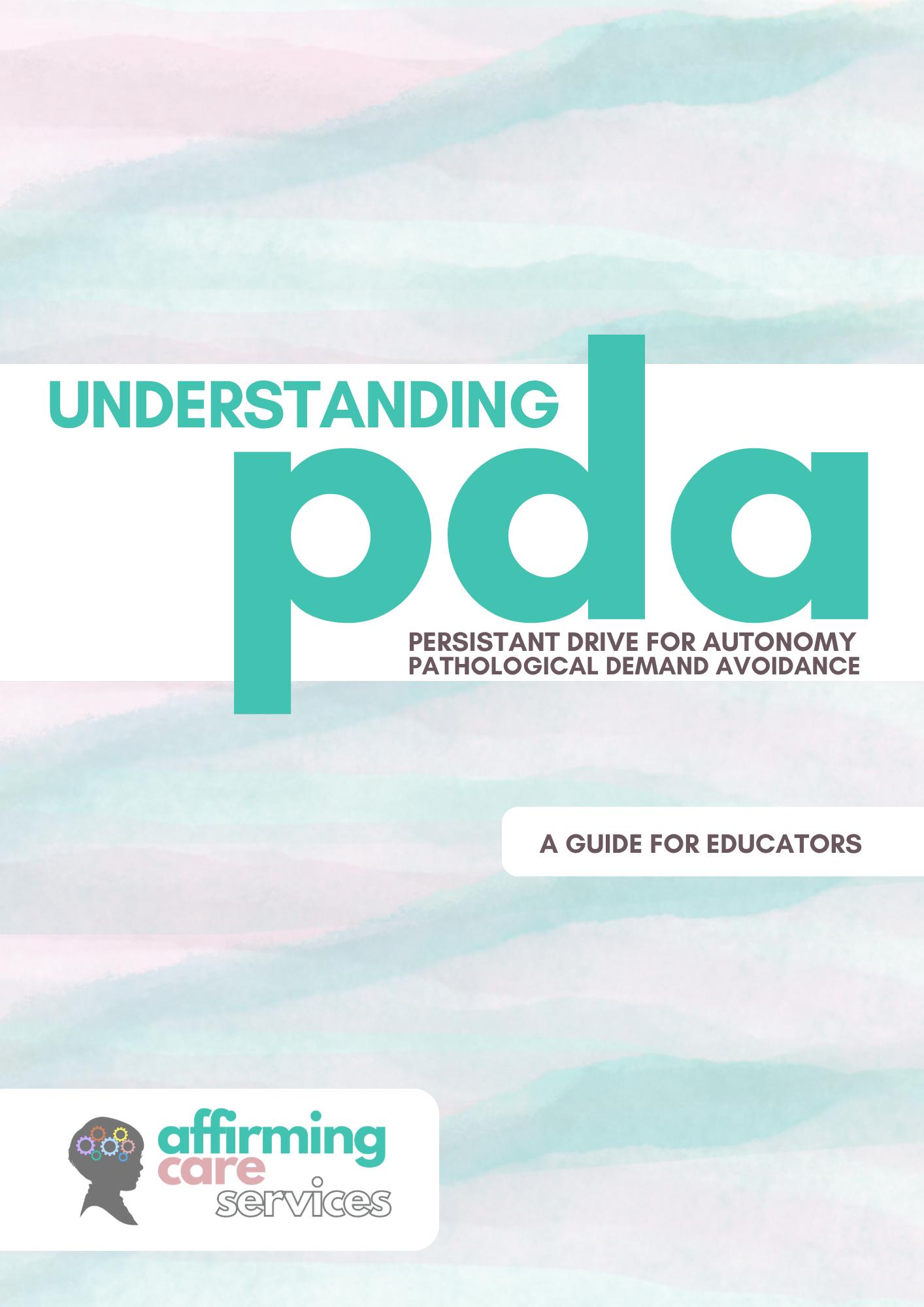
Understanding PDA: A Guide for Educators is a practical, neuroaffirming resource designed to help teachers, education support staff and school leaders better understand Pathological Demand Avoidance, also known as a Persistent Drive for Autonomy.
The guide explores how demand sensitivity may present at school, why everyday expectations can trigger distress and how traditional behaviour or compliance-based approaches may unintentionally escalate a student’s nervous system. It offers clear, practical strategies for reducing pressure, building trust, supporting regulation and creating greater flexibility, safety and participation in the classroom.
Accessible, compassionate and easy to apply, this guide helps educators look beyond behaviour and respond to PDA students with curiosity, understanding and respect.
