
Stepping Up With Confidence: Supporting Neurodivergent Children to Transition to High School
Starting high school is a significant transition for any child. There is a new environment to navigate, different teachers and classrooms, changing friendships, greater independence and many unfamiliar expectations.
For neurodivergent children, these changes can bring additional uncertainty. A student may be wondering how they will find their classrooms, manage their timetable, keep track of their belongings, travel to school, make friends or ask for help when they need it.
A supported transition gives children time to understand what is changing, develop practical skills and enter high school feeling more prepared.
More than getting to know the school
Most secondary schools offer orientation activities, and these can be very helpful. However, neurodivergent students may need more time and support to process what high school will mean for them personally.
The transition is not only about learning where the library is or meeting a new teacher. It can involve:
moving between classrooms throughout the day
managing books, devices, homework and deadlines
understanding new social expectations
communicating electronically and safely online
travelling more independently
coping when plans change
recognising when support is needed
knowing who to approach and what to say
When these areas are explored before high school begins, children have an opportunity to ask questions, practise skills and develop strategies without the pressure of already being in the middle of the transition.
Why preparation matters
Uncertainty can place a significant load on a child’s nervous system. When many parts of a new environment feel unpredictable, it can become harder to regulate emotions, remember information, communicate clearly or participate confidently.
Preparation does not mean trying to plan for every possible situation. It means reducing some of the unknowns and helping each child build a practical toolkit for the challenges they are most likely to encounter.
A supported transition can help children understand what to expect, recognise their own needs and identify the people, strategies and systems that can help them. It can also reinforce an important message: needing support does not mean they are not ready for high school.
Finding connection and belonging
For many children, the social side of starting high school brings the greatest concern.
Friendship groups may change as students move to different schools. New social dynamics emerge, electronic communication becomes more important and children may feel pressure to find where they belong.
Neurodivergent children can be particularly vulnerable to feeling isolated or misunderstood, especially if they have experienced bullying, exclusion or difficult friendships during primary school.
Transition support should not focus on teaching children to mask their differences or perform a particular version of “fitting in”. Instead, children can be supported to understand their values, recognise healthy relationships, identify people with shared interests and develop confidence in communicating their boundaries.
Finding your tribe is not about becoming like everyone else. It is about finding people and spaces where you feel safe to be yourself.
Building practical independence
The move to high school often comes with a sudden increase in expectations around organisation and independence.
Students may be expected to follow a timetable, move between classes, bring the correct materials, monitor electronic platforms, remember homework and plan ahead. For children with executive functioning differences, knowing what they need to do does not always mean they can reliably organise and complete it without support.
Practical preparation can help children identify systems that work for them. This might include visual reminders, checklists, colour coding, calendar systems, routines for packing a bag or ways to break larger tasks into manageable steps.
The aim is not perfect organisation. It is helping each student create enough structure around themselves to make high school more manageable.
Knowing how to ask for help
Self-advocacy is one of the most valuable skills a child can carry into secondary school.
Children need to know who they can approach, how to explain what is happening and what kinds of support they can request. This might include asking for instructions to be clarified, requesting additional processing time, communicating sensory overwhelm, seeking support with a friendship issue or letting someone know they are becoming distressed.
Children should not be expected to manage every difficulty independently. Genuine independence includes knowing when and how to access support.
High School Step Up
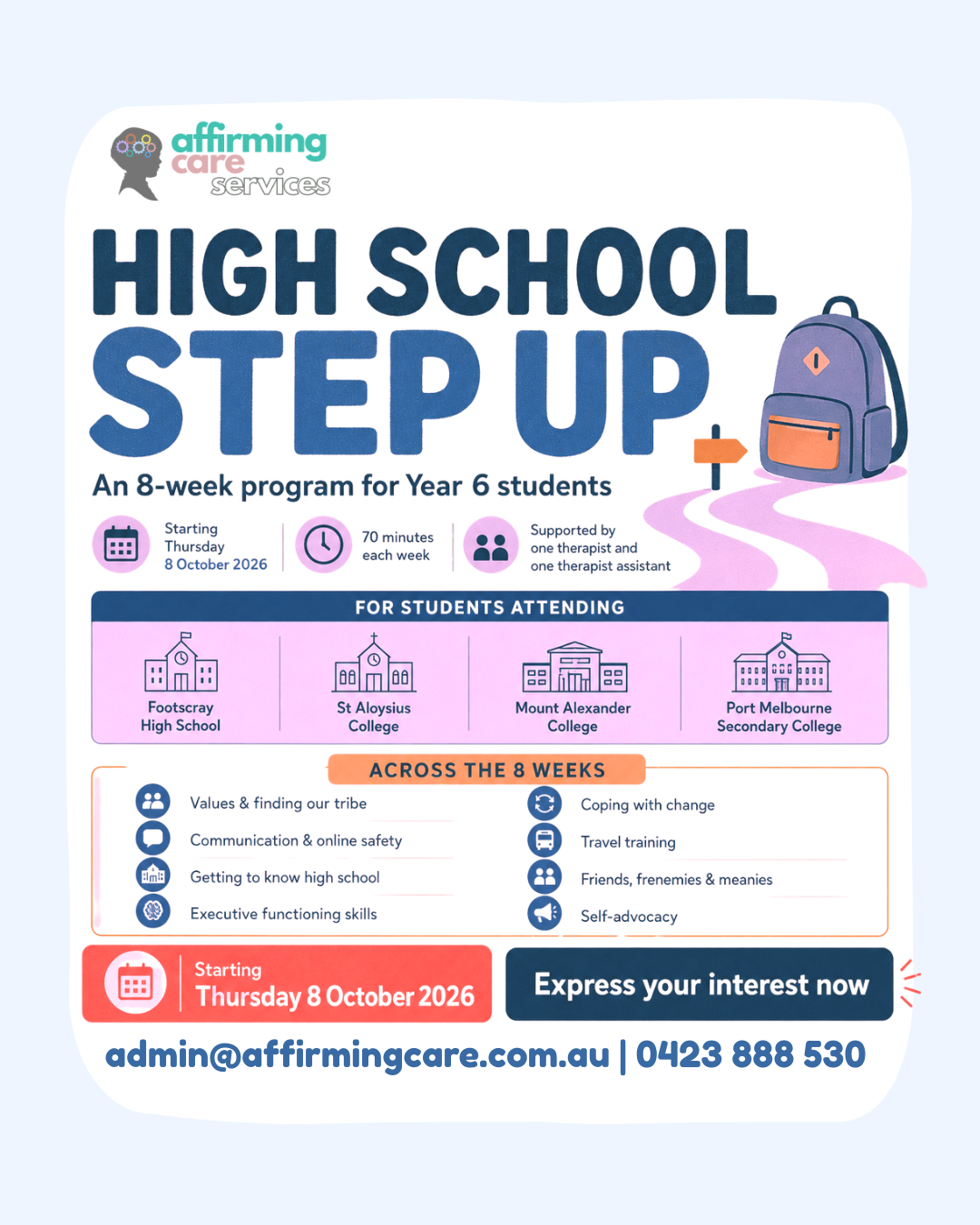
Affirming Care Services is offering an eight-week High School Step Up program for Year 6 children who will be attending:
Footscray High School
St Aloysius College
Mount Alexander College
Port Melbourne Secondary College
The program begins on Thursday 8 October 2026, with each weekly session running for 70 minutes. Sessions will be supported by one therapist and one therapist assistant.
Across the eight weeks, children will explore:
Understanding our values and finding our tribe
Exploring identity, belonging, shared interests and the qualities that matter in friendships.Electronic communication and staying safe online
Navigating group chats, messages, privacy, boundaries and safe online decision-making.Getting to know our high school
Special guest speakers from each school will visit to answer students’ questions and help make the transition feel more familiar.Setting up for success
An introduction to executive functioning skills, including organisation, routines, planning and managing school materials.Coping with change
Developing self-management strategies for uncertainty, overwhelm and big feelings.Travel training
Planning the journey to school and knowing what to do if transport is delayed, a route changes or something goes wrong.Friends, frenemies and meanies
Understanding friendship challenges, recognising unhealthy dynamics and navigating social situations.Self-advocacy
Knowing how to get help, who to approach and what to ask for.
Starting high school with a stronger foundation
A successful transition does not mean a child begins high school without any worries. It means they enter with more information, useful strategies, familiar connections and a clearer understanding of where support is available.
High School Step Up gives neurodivergent children a dedicated space to prepare for the practical, emotional and social parts of secondary school alongside peers heading to the same schools.
If your child is in Year 6 and will be attending one of the participating schools in 2027, contact Affirming Care Services to express your interest or learn more about whether the program may be a good fit.
